
What is a site acceptance test (SAT)?
The test that proves a system works at the customer's site, with the real building, items and software, before handover. This page covers the SAT steps, what to measure and common mistakes.
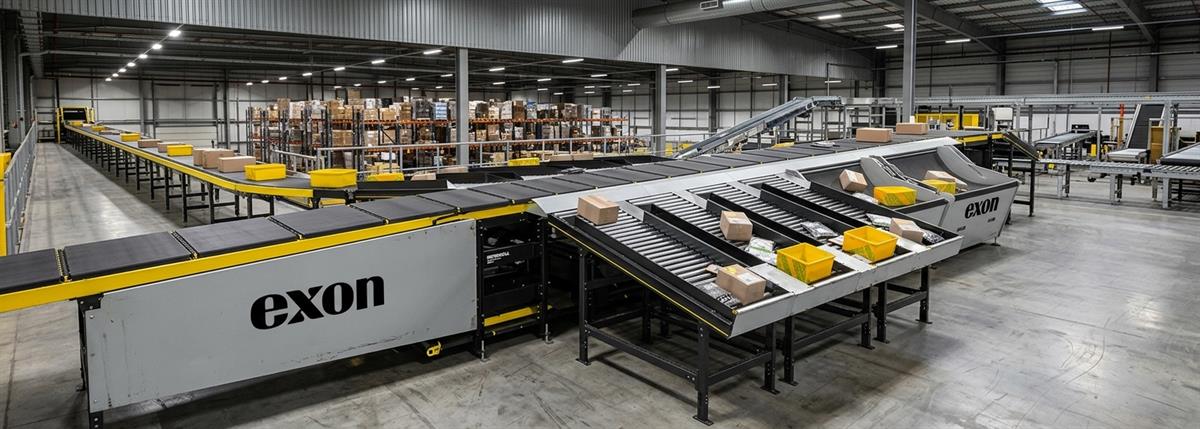
-
1Mechanical and electrical checks
Installation, alignment, wiring and safety circuits are checked on site.
Conveyor Systems -
2Functional tests
The functional tests from the FAT are repeated in the real building.
Sortation Systems -
3Integration test
Real orders and destinations are run with the customer's WMS.
Sortation Systems -
4Measurement and reading
Barcode reads, dimensions and weights are checked with real items.
DWS Systems -
5Throughput and endurance
The line runs with real flow for the agreed period. Counts and stops are logged.
Sortation Systems -
6Acceptance and handover
Open items are closed, training is completed and the acceptance certificate is signed.
Process flow. Yellow tags show the Exon system used in that step.
Definition
A site acceptance test (SAT) is the test of an installed and commissioned system at the customer's site. It runs in the real building, with real items and the customer's own software. It follows a protocol agreed in advance. When the SAT passes, the customer takes over the system. The acceptance certificate is signed and operation begins.
Other names: SAT, site acceptance testing, on-site acceptance test.
What does the SAT prove?
The factory acceptance test (FAT) shows that equipment and software meet the specification in the factory. The SAT tests everything the factory cannot. That includes the building's floor and layout. It also covers live message traffic with the customer's WMS, the real item mix and operators running the line. The line is accepted only if it reaches the planned throughput under these conditions.
That is why, next to the functional tests, integration and throughput tests are decisive in a SAT. The throughput test is not a short demo. It is an endurance run with real flow for the period written in the protocol.
How is a SAT carried out? 6 steps
- Mechanical and electrical checks: Installation, alignment, wiring and safety circuits are checked on site. (Conveyor Systems)
- Functional tests: The functional tests from the FAT are repeated in the real building. (Sortation Systems)
- Integration test: Real orders and destinations are run with the customer's WMS. (Sortation Systems)
- Measurement and reading: Barcode reads, dimensions and weights are checked with real items. (DWS Systems)
- Throughput and endurance: The line runs with real flow for the agreed period. Item counts and stops are logged. (Sortation Systems)
- Acceptance and handover: Open items are closed and training is completed. The acceptance certificate is signed.
Acceptance testing in Exon projects
In Exon's project process, on-site commissioning follows the FAT. Handover and acceptance come next. Exon engineers run commissioning and site testing. Operators and maintenance teams are trained. After acceptance, Exon provides 24/7 support. Company details: About Us.
- Sortation SystemsChute accuracy, recirculation and throughput testsView →
- Conveyor SystemsLine flow, merge and safety testsView →
- DWS SystemsMeasurement accuracy and barcode read rateView →
What the SAT protocol must define
- Throughput definition: Which throughput is measured? The machine's theoretical value, or the line's hourly output with the real item mix? See Throughput.
- Test duration: Over how many hours or shifts are throughput and availability measured?
- Item mix: Does the share of cartons, polybags and envelopes in the test match real operation?
- Reads and accuracy: How are read rate (%) and the share of items reaching the correct chute counted? Who is responsible for no-reads?
- Stop classification: Which stops count against the system, and which against operations (chute not emptied, no items at induction)? See MTBF and MTTR (mean time between failures and mean time to repair).
- Integration: Are WMS response times and faulty messages in the test scope?
- Training and documents: Are operator and maintenance training, maintenance instructions and the spare-parts list conditions of acceptance?
- Open items: Which items block acceptance, which do not, and their closing dates.
Common mistakes
- Booking operational stops against the system. A line may stop because chutes are not emptied or induction is not fed. Counting that as a system failure skews the result. Define stop classes in advance.
- Testing too briefly. A one-hour run does not show warm-up, jams or shift-change effects. Plan the throughput test long enough.
- Accepting with test items. A test with selected, neat cartons does not represent real polybags and irregular items.
- Scheduling the SAT inside peak season. If testing and training clash with peak, either the test is cut short or operations suffer. Plan the schedule to finish before peak.
Frequently asked questions
What does SAT stand for?
In industry, SAT means site acceptance test. It describes testing an installed system at the customer's site and taking it over.
What is the difference between FAT and SAT?
The FAT takes place at the manufacturer's facility before shipment. It shows the equipment meets the specification. The SAT takes place at the customer's site after installation. It shows the system reaches the planned performance with the real building, items and WMS.
What happens after the SAT?
The acceptance certificate is signed and the system goes into operation. The maintenance and support period begins. Any open items are recorded with closing dates.
What if the SAT fails?
Findings are logged, fixes are made and the affected test items are repeated. Which items are repeated, and under which conditions, should be set in the protocol in advance.
Related terms
Last updated: