
What is an AGV?
A driverless vehicle that carries loads along defined routes. This page explains how an AGV navigates. It also covers when an AGV is the right choice and the questions to ask before a project.
In short
- What it is: A driverless vehicle that carries loads along defined routes
- Where it is used: Pallet and tote transport, feeding from production to the warehouse, end of line, transfers between conveyors
- When to choose it: Fixed flow, routes that rarely change, many repetitive moves
- Exon's role: Installed and commissioned with the conveyor and sorter lines as part of a turnkey project
Definition
An AGV (automated guided vehicle) is a driverless vehicle that carries loads. In warehouses and factories it moves pallets, totes or carts along predefined routes. It finds its way with magnetic tape, wires or markers on the floor. Lasers and map references can also be used. Fleet management software assigns tasks to the vehicles. The same software manages traffic and charging.
Other names: automated guided vehicle, automatic guided vehicle, AGV robot, driverless transport vehicle.
How does an AGV navigate?
The navigation type sets two things: how flexible the AGV is and how much floor work it needs.
- Magnetic tape or floor wire: The vehicle follows tape on the floor or a buried wire. Installation is simple. Changing the route means relaying the tape or wire.
- Floor markers (QR codes, magnetic spots): The vehicle reads a grid of markers to locate itself. It can choose free paths between markers. It does not leave the marked area.
- Laser reflectors: Reflectors are mounted on walls and columns. The vehicle measures them with a laser and triangulates its position. This suits precise pallet pick-up and drop-off.
- Natural (contour) navigation: The vehicle scans fixed structures such as walls, columns and racks. It finds its place on the map from this scan. No extra floor or wall markers are needed. This technology blurs the line between AGVs and AMRs.
Whatever the navigation type, an AGV follows routes defined in software. If an obstacle appears, the safety scanner slows and stops the vehicle. It waits until the obstacle is gone. This is the key difference from an AMR. An AMR can calculate a new route around the obstacle. An AGV stays on its defined route.
Types of AGV
- Forklift AGV: Picks a pallet from the floor or rack and drops it elsewhere. Used at docks, buffer areas and line feeding.
- Unit-load AGV with top conveyor: Carries a roller or belt conveyor on top. It takes the load from a fixed conveyor and transfers it to another.
- Tugger AGV: Pulls a train of carts. Common for feeding material to production lines.
- Underride AGV: Drives under a rack or cart, lifts it and carries it.
When is an AGV the right choice?
- When the flow is fixed and repetitive: If loads move between the same two points all day, an AGV gives a steady, predictable flow.
- When routes can be separated from people and forklifts: In mixed traffic, a fixed route means frequent stops. In dedicated aisles, the AGV runs without interruption.
- When precise positioning is needed: Transfers to conveyors or racks need repeatable positioning. A defined route makes this easier.
- When a conveyor line does not make sense: The distance may be long, the flow sparse or the aisle shared. AGV transport is then considered instead of a fixed conveyor. If the flow is dense and continuous, a fixed conveyor is often the better option.
Which Exon systems does it work with?
- Robotic AutomationRobot cells, end-of-line palletizing; AGV/AMR transport if the project requires itView →
- Conveyor SystemsTransfer points where the AGV picks up and drops loadsView →
- AS/RS SystemsTransport between storage in/out points and production or shippingView →
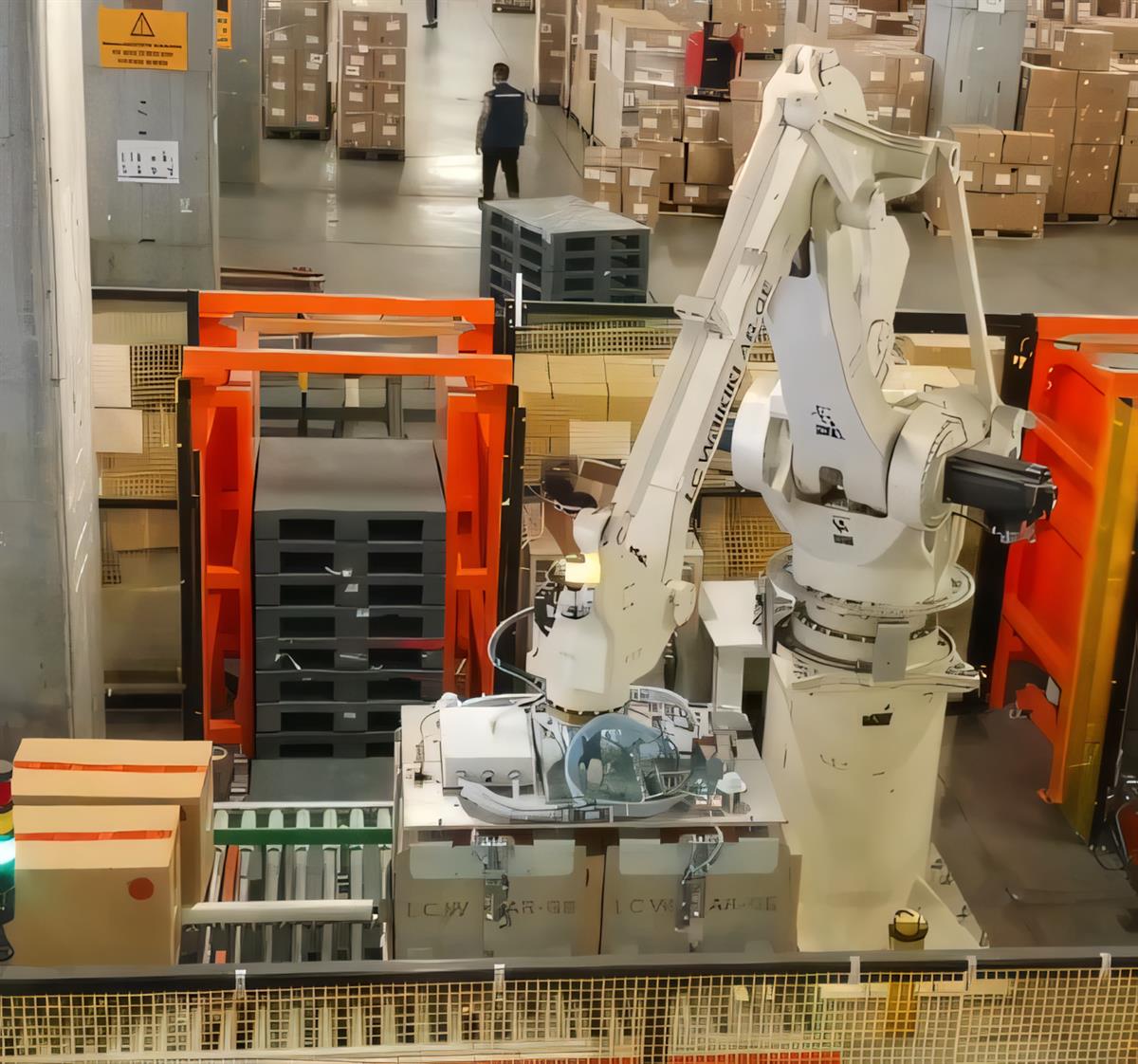
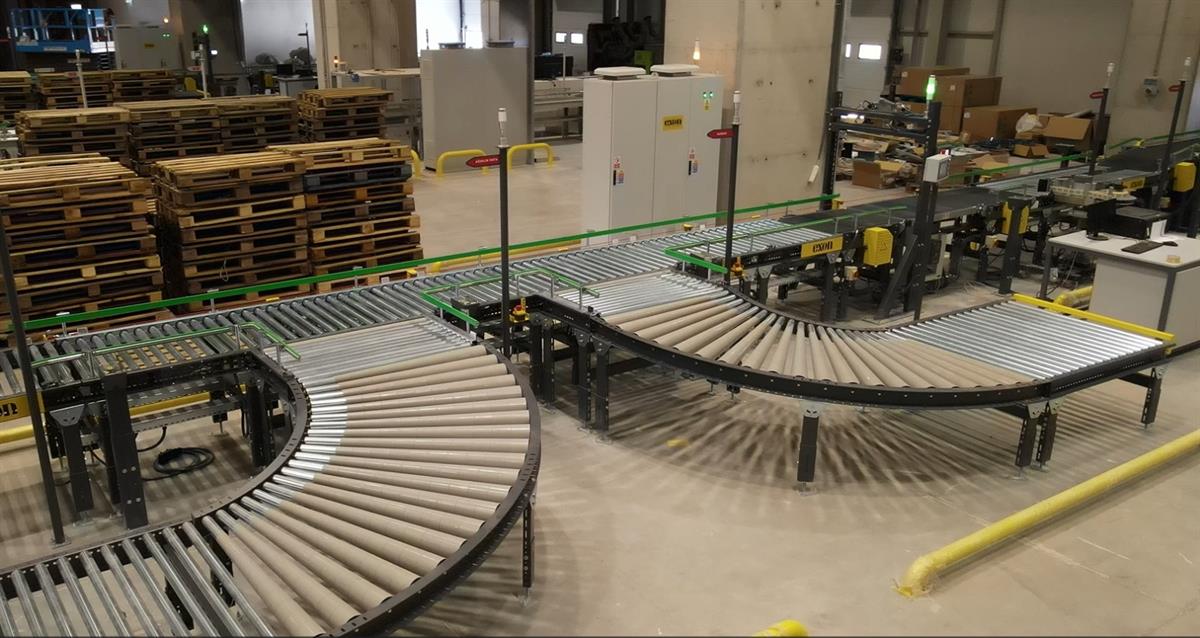
Exon designs, installs and commissions AGVs as part of a turnkey project. The vehicles are planned together with conveyors, sorters and storage systems. Vehicle and line can communicate through the warehouse control system (WCS). Exon follows the EN ISO 3691-4 safety standard in AGV projects.
7 questions for an AGV project
- What will be carried? Load type (pallet, tote, cart), weight and dimensions define the vehicle. List non-standard pallets from the start.
- How many moves per hour? The number of tasks in the peak hour sets the fleet size. Distance and pick-up and drop-off times count too. Do not forget charging time.
- Is the floor suitable? Floor flatness, slopes, joints and ramp transitions matter. They affect navigation and load safety.
- How will traffic be separated? Crossings of people, forklifts and AGVs are set in the design. Doors and passages are part of this.
- Charging strategy: Opportunity charging or battery swap? Opportunity charging means short charges during idle moments. Charger positions must not disrupt the flow.
- Integration: Will tasks come from the warehouse management system (WMS) or the control software? The AGV exchanges signals with conveyors, doors and lifts. Define this exchange in writing.
- Safety: EN ISO 3691-4 sets safety requirements for driverless industrial trucks. Safety fields, speed limits and the risk assessment should be part of the acceptance test.
Common mistakes
- Sizing the fleet on average tasks. If peak hour, charging and waiting times are ignored, there will not be enough vehicles.
- Leaving transfer points to the end. Transfer height, position tolerance and signal exchange between AGV and conveyor must be clear. If not, the system stalls exactly there.
- Expecting full throughput in mixed traffic. An AGV sharing an aisle with people and forklifts slows down often for safety. It may not reach its theoretical throughput.
- Ignoring building changes. If the rack layout or line position changes, routes, markers and maps are updated. Plan this work and its cost from the start.
Frequently asked questions
What does AGV stand for?
Automated guided vehicle. Some sources also say automatic guided vehicle.
What is the difference between an AGV and an AMR?
An AGV follows defined routes. It stops and waits at an obstacle. An AMR (autonomous mobile robot) senses and maps its surroundings. It calculates a new route around the obstacle. AGVs suit predictable, fixed flows. AMRs suit areas that change often and are shared with people.
What makes up an AGV system?
An AGV system consists of vehicles and navigation infrastructure. The infrastructure may be tape, markers, reflectors or a map. Fleet management software, chargers and the link to the WMS and control software are also part of it. A vehicle alone is not a system.
Can AGVs be installed in an existing warehouse?
Usually yes. The floor, aisle widths and traffic pattern are reviewed. The navigation type is chosen to match. Vehicles with natural navigation need the least floor or wall work.
Related terms
Last updated: