
What is recirculation on a sorter?
A parcel that cannot be dropped at its destination chute and goes around the loop sorter again. This page explains the causes, the effect on throughput and how to reduce it.
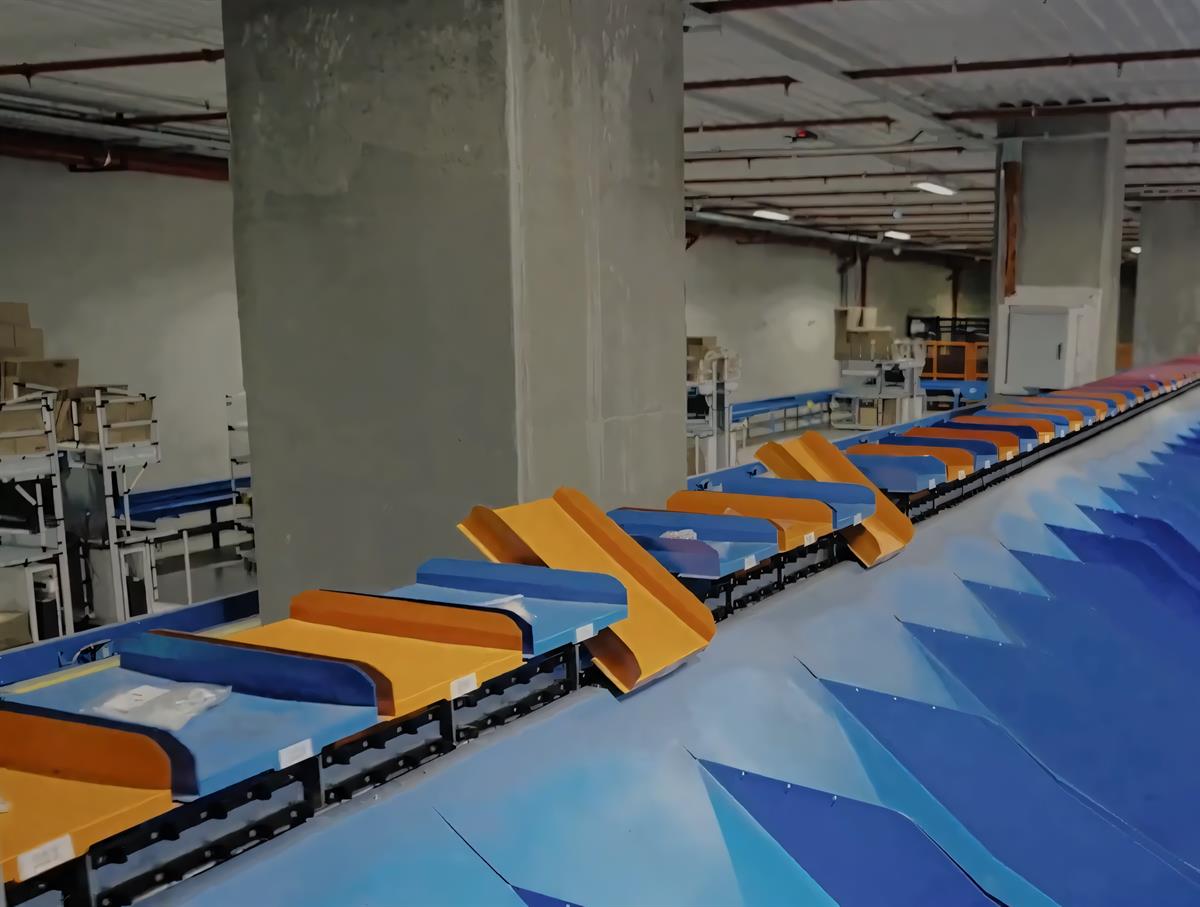
-
1Induction
The parcel is scanned and inducted onto the sorter.
Sortation Systems -
2Arrival at destination
The parcel reaches its assigned chute. The system checks that the chute is open and the destination is known.
Sortation Systems -
3Recirculation
A parcel that cannot be dropped stays on the carrier and goes around the loop again.
Cross-Belt Sorter -
4Retry
When the parcel reaches the chute again and the chute is open, it is dropped.
Sortation Systems -
5Reject chute
If the recirculation limit is exceeded, the parcel goes to the reject or manual-handling chute.
Sortation Systems
Process flow. Yellow tags show the Exon system used in that step.
Definition
Recirculation happens when a parcel cannot be dropped at its destination chute and stays on its carrier. On a loop sorter, the parcel goes around again and passes the sorter a second time. Common causes are a full chute, a no-read barcode or a missing destination. A recirculating parcel occupies a carrier that could take a new parcel. That is why the recirculation rate is a key indicator of a sorter's real throughput on site.
Other names: sorter recirculation, recirc, recirculated parcel, go-around.
Parcels cannot recirculate on linear sorters such as narrow-belt and pop-up sorters. A parcel that cannot be diverted goes to the reject chute at the end of the line or to a return conveyor. The concept is the same: the parcel was not sorted on the first pass.
How a parcel recirculates: 5 steps
- Induction: The parcel is scanned and placed on an empty carrier on the sorter. (Sortation Systems)
- Arrival at destination: The parcel reaches its assigned chute. The control system checks whether the chute is open and the destination is known. (Sortation Systems)
- Recirculation: If the chute is full, there is no destination or the discharge timing was missed, the parcel stays on the carrier. It completes the loop and comes around again. (Cross-Belt Sorter)
- Retry: When the parcel reaches the chute again and the chute has been cleared, it is dropped. (Sortation Systems)
- Reject chute: If the set recirculation limit is exceeded, the parcel goes to the reject or manual-handling chute. An operator fixes the label and re-inducts the parcel. (Sortation Systems)
What causes it?
| Cause | What happens | What to do |
|---|---|---|
| Full chute | The bag or chute was not cleared, so the chute is closed | Chute-clearing organization, an extra chute for high-volume destinations, full-chute alerts |
| No-read barcode | Damaged, folded or missing label | Scanning setup, multi-side scanning, label quality |
| No destination | The barcode has no destination in the system | Software integration, data arriving on time |
| Discharge error | The parcel slid, was longer than the carrier or the timing was missed | Correct gapping at induction, a sorter type that fits the item mix |
| Unbalanced load | Some chutes are always full at peak hour | Balancing chute assignment by volume |
One of the most common causes on site is the full chute. If operators cannot clear chutes fast enough, chutes keep closing. Recirculation climbs far above plan. The sorter fills with parcels looking for a free chute.
Effect on throughput
Each recirculating parcel uses a carrier for a full loop. That carrier could have taken a new parcel. As recirculation rises, induction points struggle to find empty carriers. Queues build on the induction line and the sorter runs below its technical capacity. Above a certain threshold, the loop can fill up completely. So the control software needs a recirculation limit and loop-full protection.
Recirculation is not bad in itself. During a short chute-full event, it gives the parcel a second chance without losing it. The problem is a rate that stays high.
What to track: questions for the acceptance test
- How is the recirculation rate measured: share of total parcels, per hour, by cause?
- Can the rate be reported by cause (full chute, no-read, no destination)?
- What is the recirculation limit and can it be set in the software?
- How does induction behave when the loop is full?
- Is there a manual-handling station and a re-induction path for reject-chute parcels?
- Is the throughput test run with the peak-hour item mix and real chute-clearing conditions?
Common mistakes
- Taking recirculation for a sorter fault. The issue is often not the sorter itself but uncleared chutes or read quality.
- Running the throughput test with empty chutes. Throughput measured without real chute clearing will not repeat on site.
- Assigning chutes without looking at volume. A high-volume destination on a single chute stays full at peak hour.
- Not tracking the data. If you do not report why parcels recirculate, you cannot tell operator speed, labels and software apart.
Related Exon systems
- Sortation Systems: control software and reporting developed by Exon's own team
- Cross-Belt Sorter, Tilt-Tray Sorter: loop sorters
- DWS Systems: barcode scanning, dimensions and weight
- Conveyor Systems: reject and re-induction lines
Frequently asked questions
What does recirculation mean on a sorter?
It is a parcel that could not be dropped at its destination chute and passes the sorter a second time. The parcel stays on its carrier and goes around the loop again.
Why do parcels recirculate?
The most common causes are a full chute, a no-read barcode, a parcel with no destination in the system and missed discharge timing.
How do you reduce the recirculation rate?
First, measure each cause separately. For full chutes, look at chute clearing and chute assignment. For read errors, check the scanning setup and label quality. For parcels with no destination, review the software integration.
Do parcels recirculate on a linear sorter?
No. A parcel that cannot be sorted goes to the reject chute at the end of the line or to a return line. The rate is tracked the same way.
Related terms
Related Exon systems
Last updated: