
What is a pop-up wheel sorter?
A sorter type that uses angled wheels rising at set points on a conveyor line to divert cartons to a side line. This page explains how it works, which items it suits and how to choose it.
In short
- Scanning: The barcode is read on the line; the destination comes from the control software.
- Tracking: The control software tracks the carton's position along the line.
- Divert: At the destination, the wheels rise, angle and turn the carton onto the side line.
- Discharge: The carton moves to a side conveyor, chute or station; the wheels drop.
Definition
A pop-up wheel sorter diverts cartons from the main line to a side line with rising wheels. Divert modules are built into the conveyor line. The wheels in a module rise above the conveying surface and angle toward the exit. A carton that does not need diverting passes straight over while the wheels are down. It is used on linear lines to sort cartons and totes with a flat, firm base. The number of exits is set per project.
Other names: pop-up sorter, wheel sorter, wheel divert sorter. A pivot wheel sorter is a close relative: its wheels do not rise but turn at the surface to steer the item.
How does it work?
- Scanning: The barcode is read as the carton moves along the line. The destination comes from the warehouse management system (WMS) or the warehouse control system (WCS).
- Tracking: The control software tracks the carton along the line with encoders and sensors. It calculates when the carton will reach each module.
- Divert: As the carton enters its destination module, the wheel group rises and angles to the direction of travel. The wheels grip the carton's base and push it onto the side line. The divert angle varies by project and need. A module can divert to one side or both sides.
- Discharge: The carton moves to a side conveyor, a chute or a packing station. The wheels drop and the next carton continues straight.
The angle affects how the carton enters the side line and how much space the exit takes. So it is set in the project together with layout and throughput.
When does it fit, and when not?
A pop-up wheel sorter works well on single linear flows. The item mix should be mostly cartons and totes. Typical uses:
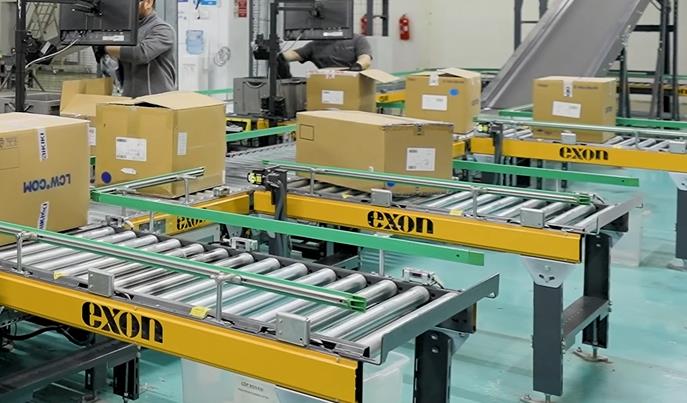
- Distributing orders to packing stations in e-commerce warehouses,
- Sorting cartons by store or region in retail distribution centers,
- Creating reject, inspection or manual-handling exits on a line,
- Adding a sort point to an existing conveyor line later.
Its limits come from the item base. The wheels grip the item from below. So grip is weak on polybags, flats, soft items and items with an uneven base. Very small or very long items can also cause problems, depending on module size. For parcel lines with a high polybag share, consider a narrow-belt or cross-belt sorter.
Comparison with other sorter types
| Criterion | Pop-up wheel | Narrow-belt | Cross-belt |
|---|---|---|---|
| Layout | Linear line | Linear line | Mostly loop |
| Suitable items | Cartons and totes with a flat, firm base | Cartons, parcels, polybags, flats | Wide item mix including polybags and fragile items |
| Divert method | Rising, angled wheels | Belts on narrow-belt carriers turn to the side | The belt on each carrier discharges to either side |
| Adding to a line | Easy; added to an existing conveyor as a module | Planned as a separate sorter line | Planned as a separate system |
Throughput is not a fixed number. It is set in the project with item length, gap between cartons, number of exits and line speed.
Pre-selection checklist
- Item mix: What share are cartons, totes, polybags and flats? What are the smallest and largest item sizes and weights?
- Base condition: Do cartons have tape, label residue or bumps underneath? Do wet or soft cartons arrive?
- Number and pitch of exits: How many exits do you need? Is the spacing enough for the carton length?
- Induction: Do cartons arrive at even gaps? If gaps are uneven, diverts are missed and cartons go to the reject chute.
- Exit clearing: What happens when side lines fill up? Is there buffer space and a full sensor at each exit?
- Growth: If the polybag share grows, is the line laid out so it can move to another sorter type?
Common mistakes
- Choosing a wheel sorter for a polybag-heavy flow. Weak grip means more missorts and manual corrections.
- Ignoring the gap between cartons. The wheels need time to rise and drop. If the gap is too small, the next carton is diverted too.
- Making exit lines too short. A full side line blocks the divert. Even if the sorter keeps running, cartons miss their destination.
- Not planning maintenance access. Wheels are wear parts. Plan module access and spare-parts stock for replacement from the start.
Exon pop-up wheel sorter
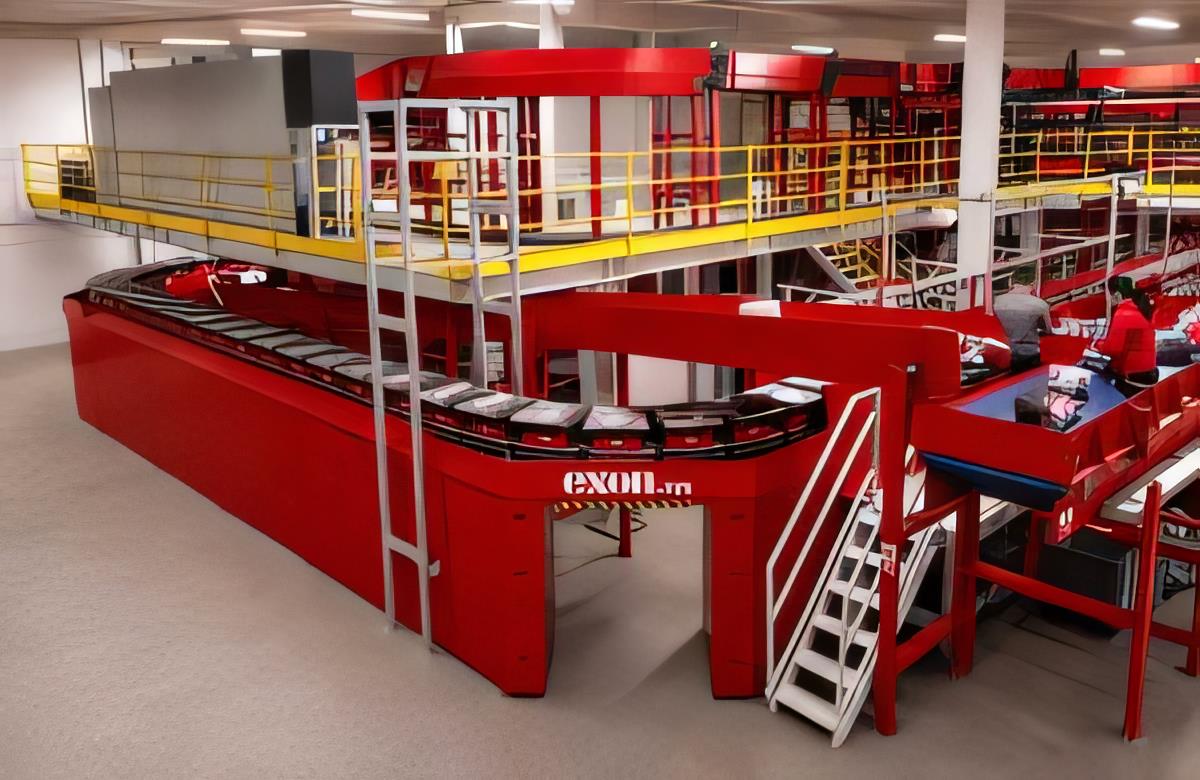
Exon designs and manufactures its pop-up sorter in-house. Its own team develops the control software. Exon also handles installation and commissioning. The sorter runs quietly on an electric-motor drive. The right sorter type is chosen in the project based on item mix and layout.
- Sortation Systems: all sorter types
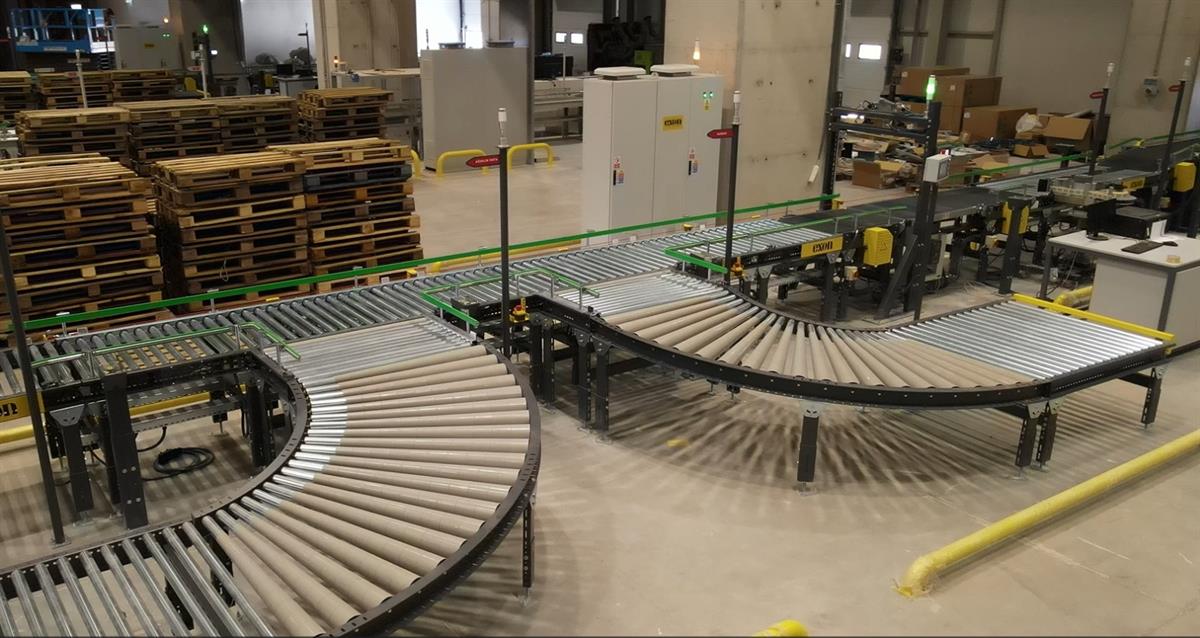
- Conveyor Systems, Belt Conveyor, Roller Conveyor: induction and exit lines
- Narrow-Belt Sorter and Cross-Belt Sorter: for polybag-heavy flows
- Sorter and conveyor cost: factors that drive the price
Frequently asked questions
Are a pop-up sorter and a wheel sorter the same thing?
Yes. Both names describe a sorter that diverts with rising, angled wheels. "Wheel divert sorter" is another common name. A pivot wheel sorter is a close type. Its wheels do not rise but turn at the surface to steer the item.
Can a pop-up wheel sorter handle polybags?
To a limited extent. The wheels grip the item from below. Polybags with a flat, firm base can be diverted. Errors rise with soft, irregular polybags. If the polybag share is high, a narrow-belt or cross-belt sorter fits better.
Can a pop-up wheel sorter be added to an existing conveyor line?
Often, yes. The divert module replaces a section of the line. Exit lines, control software and barcode scanning are planned together.
What is the throughput of a pop-up wheel sorter?
There is no fixed number. It depends on item length, gap between cartons, line speed and number of exits. It is calculated in the project.
Related terms
Related Exon systems
Last updated: