
What is sorter induction?
The conveyor section that singulates parcels, gaps them and inducts them onto the sorter in a controlled way. This page explains the induction steps and their effect on throughput.
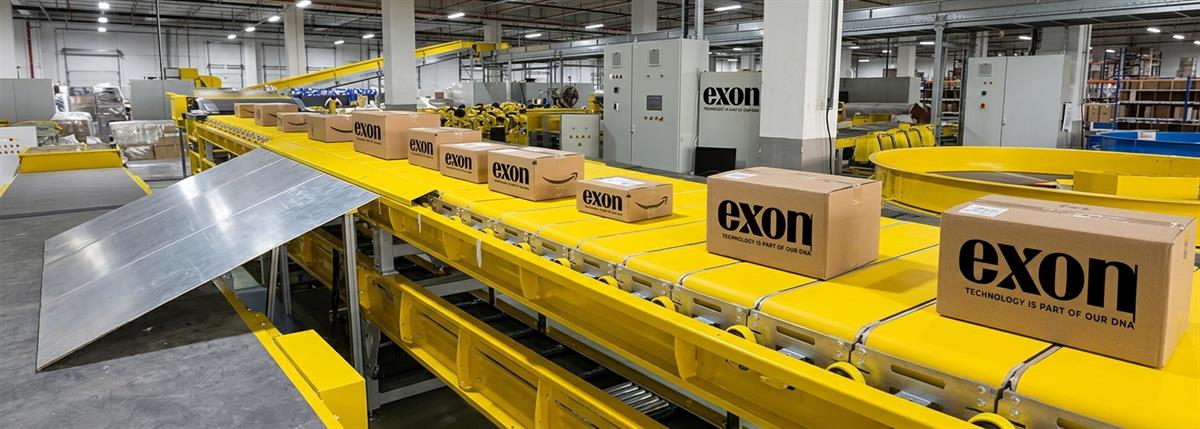
-
1Merging
Parcels from unloading and line conveyors merge onto the induction line.
Conveyor Systems -
2Singulation
Side-by-side and stacked parcels are put into a single file.
Conveyor Systems -
3Gapping
Belts running at stepped speeds create the right gap between parcels.
Belt Conveyor -
4Scanning and DWS
Barcode, dimensions and weight are captured without stopping the flow.
DWS Systems -
5Synchronized induction
Each parcel is timed onto an empty carrier or gap on the sorter.
Sortation Systems
Process flow. Yellow tags show the Exon system used in that step.
Definition
Sorter induction is the conveyor section that prepares parcels and feeds them onto the sorter. It singulates a mixed flow and creates the right gap between parcels. It reads barcode and measurement data. Then it inducts each parcel onto the sorter at the right moment. This line is one of the main factors in whether the sorter reaches its rated throughput on site. A sorter can only sort what it is fed.
Other names: induction line, induction conveyor, sorter infeed, infeed conveyor, induction station.
Flow on the induction line: 5 steps
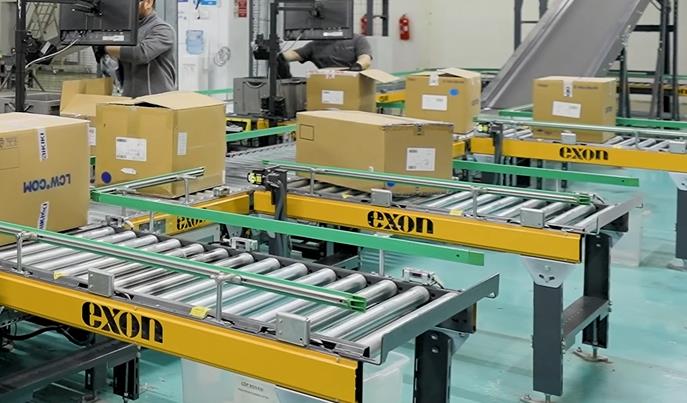
- Merging: Lines from unloading, receiving or picking merge onto the induction line. Software decides which line has priority at the merge point. (Conveyor Systems)
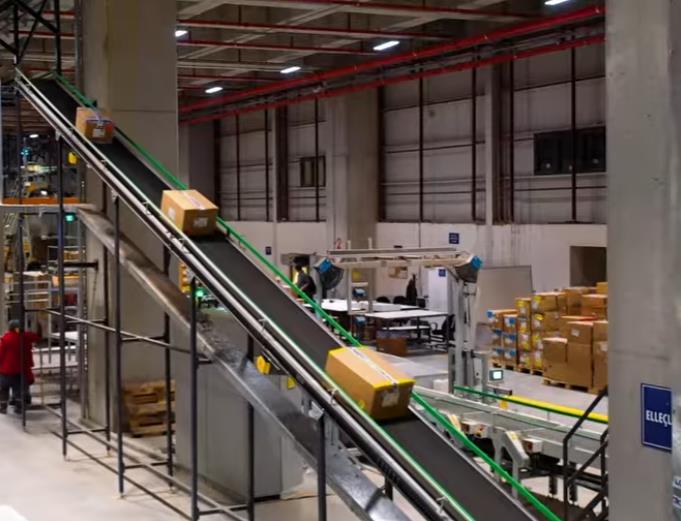
- Singulation: Stacked or side-by-side parcels are separated into a single file. At low volume, an operator does this. At high volume, an automatic singulator does it. (Conveyor Systems)
- Gapping: Short belts with individually controlled speeds set the gap between parcels. If the gap is too small, two parcels are read as one or go to the same chute. If it is too large, sorter capacity is wasted. (Belt Conveyor)
- Scanning and DWS: Barcode, dimensions and weight are captured without stopping the flow. Dimensional weight data goes to the operator's software and the destination chute is set. (DWS Systems)
- Synchronized induction: The parcel is placed onto an empty carrier or gap on the sorter at exactly the right time. On loop sorters, several induction points feed the same loop. Software tracks which carriers are empty. (Sortation Systems)
How induction sets throughput
Sorter capacity is the number of carriers or gaps that pass per hour. How many of them carry a parcel depends on induction. Three factors stand out:
- Gap quality: The more even the gaps, the fuller the sorter runs. Uneven gaps mean empty carriers or missed diverts.
- Number of induction points: On a loop sorter, one induction point may not be enough to fill the capacity. The number of induction points is planned with the layout and peak-hour volume.
- Read rate (%): A no-read parcel either goes to the reject chute or recirculates. A small drop in read rate comes back as empty sorter capacity and manual handling.
So ask for induction line throughput and the number of induction points separately from sorter throughput in every quote.
Manual or automated?
| Criterion | Manual induction (operator) | Automated induction |
|---|---|---|
| Suitable volume | Low to medium | High, with a clear peak hour |
| Item mix | Irregular, large and fragile items | Mostly cartons, polybags and flats |
| Throughput driver | Operator speed and consistency | Singulation and gapping speed |
| Label orientation | Operator turns the label up | Multi-side scanning needed |
| Space | Needs room for operator stations | Needs a long line |
Manual and automated induction can work side by side in the same facility. Standard parcels are inducted automatically. Irregular and large items go through an operator station.
Pre-design checklist
- How many parcels reach the induction line at peak hour? From how many lines do they merge?
- What share of the item mix is polybags and flats? Polybags behave differently from cartons during singulation.
- Are there enough induction points to fill the sorter's capacity?
- Will scanning be multi-side? Where will no-read parcels go?
- If the induction line stops, how much buffer space do the upstream lines have?
- Is there a separate flow for items that cannot travel on a belt?
Common mistakes
- Looking for throughput only at the sorter. On site, jams usually start at the induction line and at merge points. A fast sorter does not speed up a slow induction.
- Underestimating merge points. Where two lines merge into one, plan priority and buffer space. Otherwise one line is always waiting.
- Treating polybags like cartons. Polybags slide, stick together and have folded labels. Choose the singulation and scanning method for this behavior.
- Leaving read errors for later. Every no-read parcel goes to manual handling or recirculates. Design the scanning setup together with the line.
Related Exon systems
- Sortation Systems: sorters planned together with their induction points
- Conveyor Systems, Belt Conveyor, Roller Conveyor: merging, singulation and gapping
- DWS Systems: barcode scanning, dimensioning and weighing
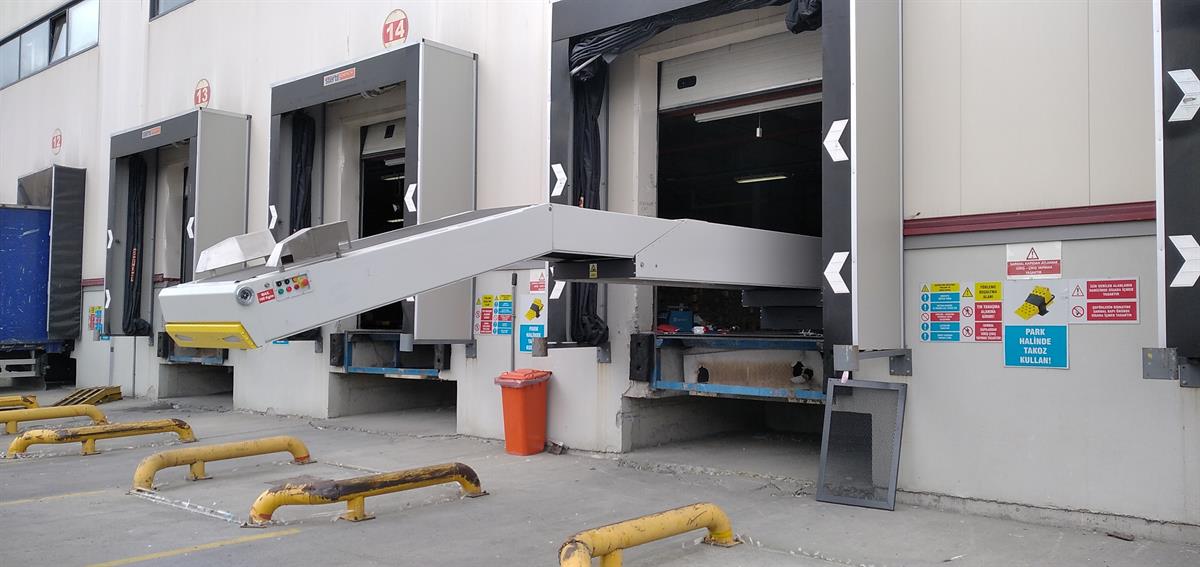
- Telescopic Conveyors: vehicle unloading; can connect to the conveyor line
Exon's own team designs, installs and commissions the induction line, the conveyors and the sorter under one control software.
Frequently asked questions
What does a sorter induction line do?
It singulates a mixed flow and creates gaps between parcels. It reads the barcode and inducts each parcel onto the sorter at the right moment. This line decides how full the sorter runs on site.
What is the difference between singulation and gapping?
Singulation puts side-by-side or stacked parcels into a single file. Gapping sets the space between parcels in that file to what the sorter needs. Singulation comes first, then gapping.
How many induction points should a sorter have?
There is no fixed number. Peak-hour volume, item mix, the speed of the induction type (manual or automated) and the sorter type are calculated together.
Can induction be added to an existing sorter later?
Often, yes. An extra induction point or an automatic singulation section can be connected to the existing system. The layout and control software must allow it.
Related terms
Related Exon systems
Last updated: