
Conveyor Systems
A conveyor system moves cartons, totes, polybags and parcels without manual handling. It links receiving, storage, picking, packing, sorting and shipping. Exon Robotics designs, builds and programs belt, roller and curved conveyors in-house. It installs and commissions complete lines for warehouses, parcel hubs and e-commerce fulfillment centers.
A line is more than a set of single conveyors. Order profile, peak-hour volume, building layout and where the line will accumulate are designed together. Accumulation, merge and divert points connect to the same control system. Barcode reading and DWS (dimensioning, weighing and scanning) connect to it too. The line works together with telescopic conveyors and sorters.

What is a conveyor system?
What is a conveyor system?
A conveyor system is a line that moves goods from one point to another. Items travel on a powered belt or rollers. Short sections can also use unpowered, free-turning rollers. In warehouses and parcel hubs it links receiving, picking, packing, sorting and shipping. Sensors and control software decide where an item stops. The software also sets its direction and speed.
Which conveyor types are there?
What types of conveyors are used in warehouses?
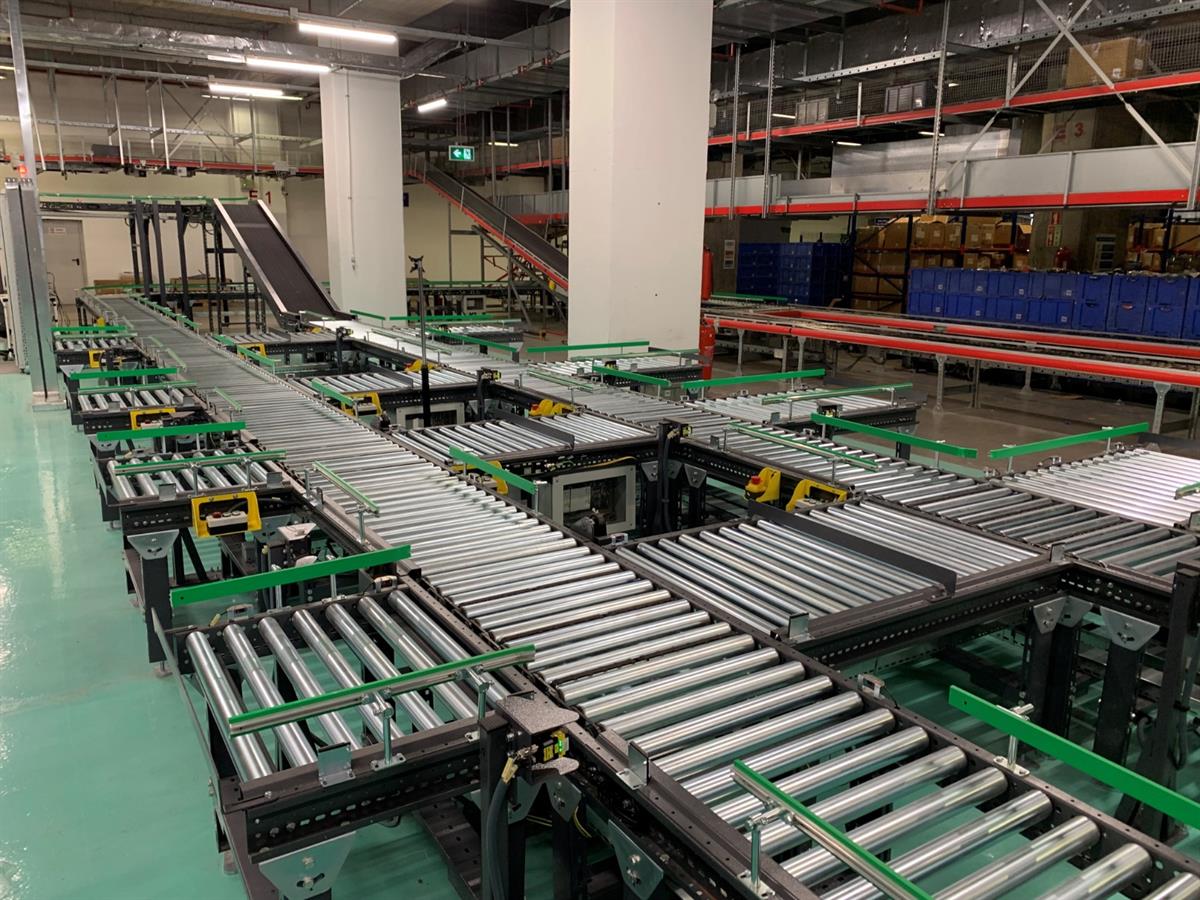
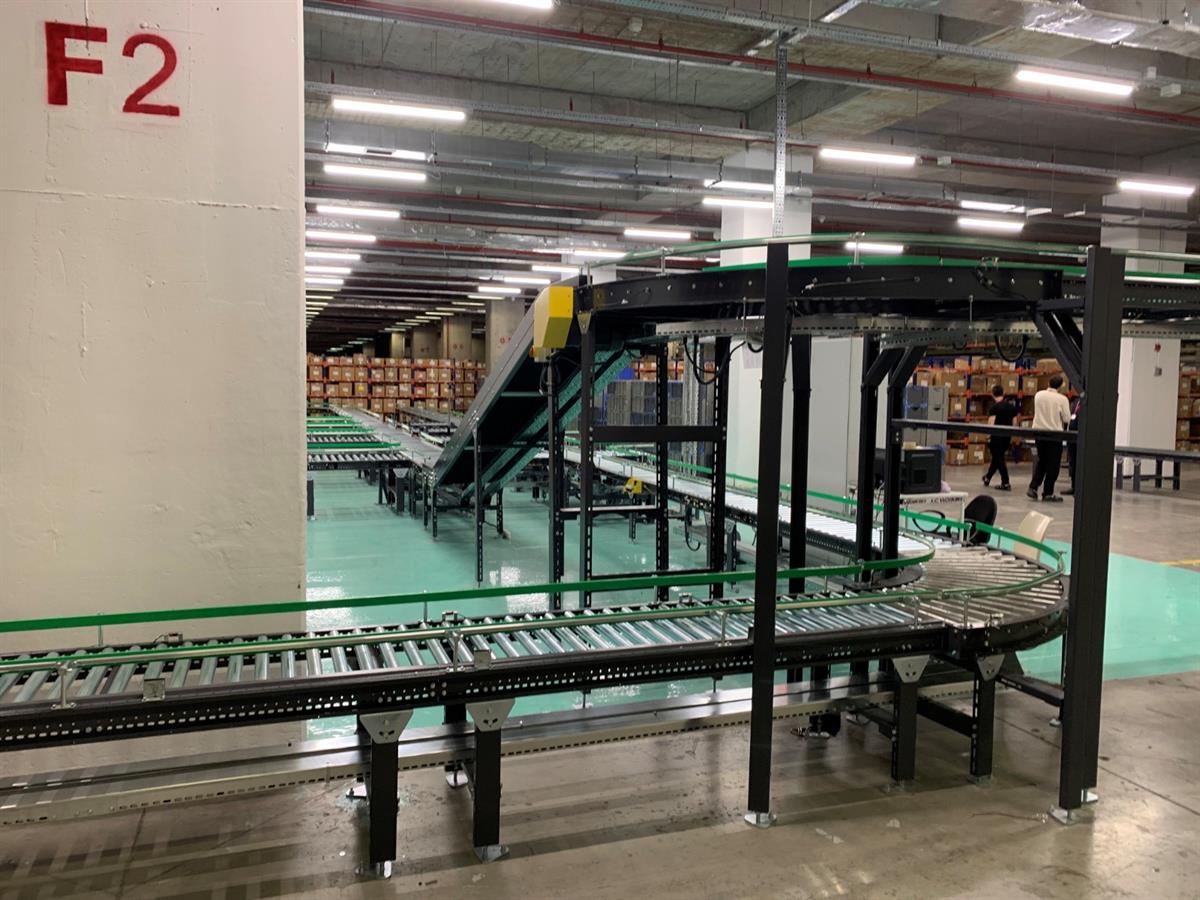
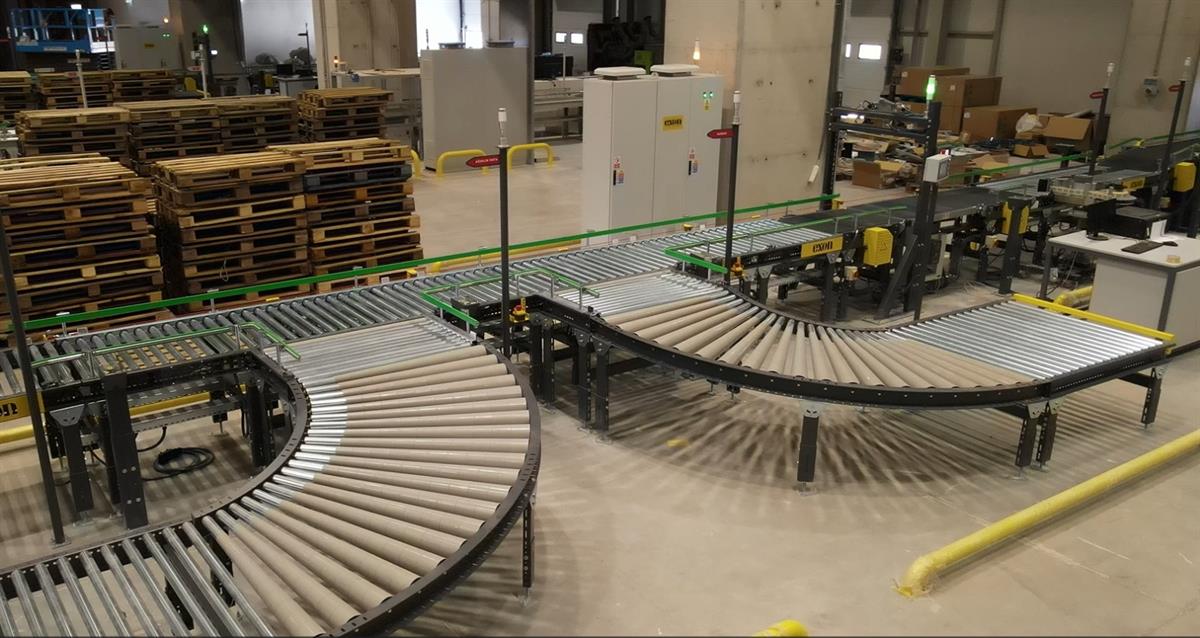
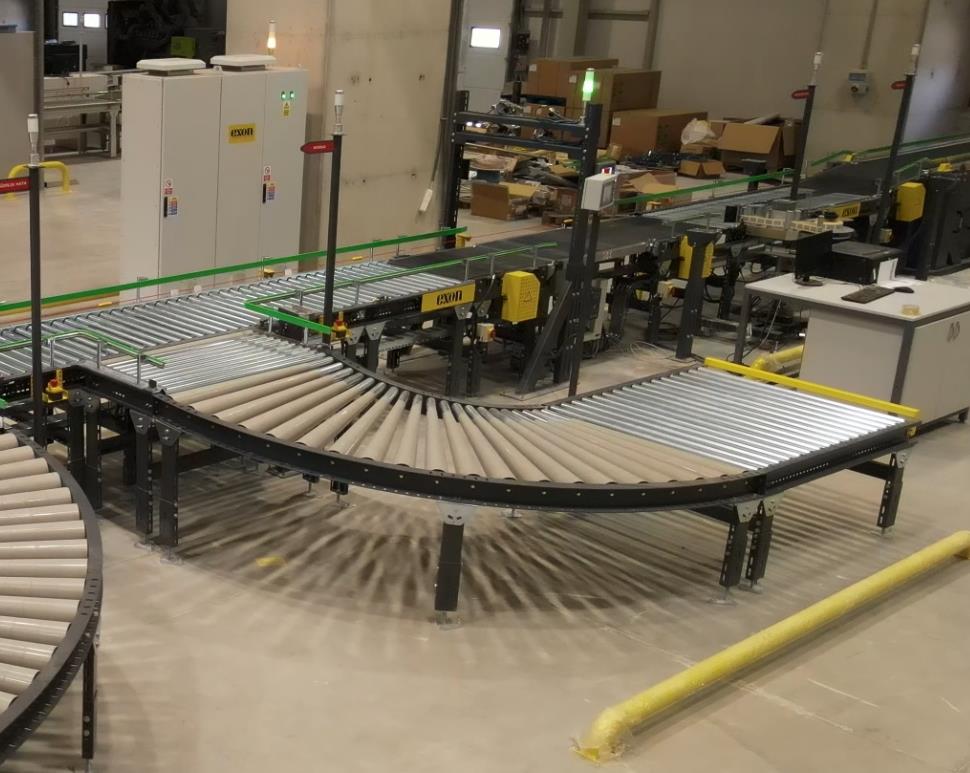
The main types in warehouse and parcel lines are belt, gravity roller, motorized roller and curved conveyors. Sections where items must wait are usually built with motorized roller conveyor. Points where lines merge and divert use dedicated modules. Exon builds all of these types. The table below shows when to choose each.
Belt or roller conveyor?
What is the difference between a belt and a roller conveyor?
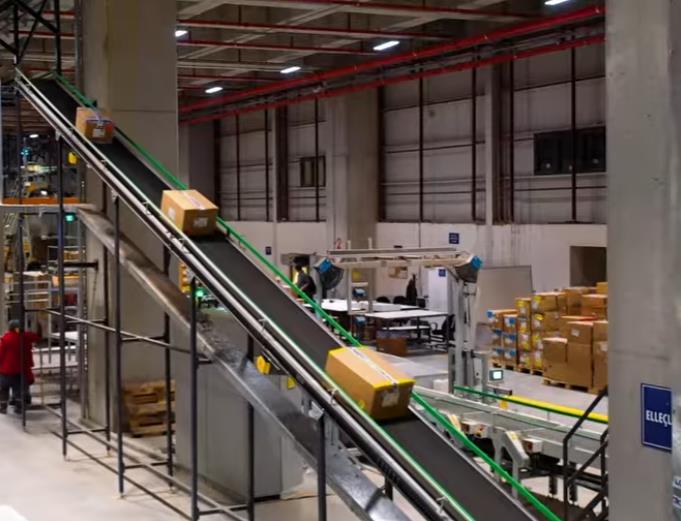
A belt conveyor carries items on a continuous belt surface. It suits polybags, envelopes, small items and items with an irregular base. It also works on inclines and between floors. A roller conveyor moves items on rollers. It is for cartons and totes with a flat, firm base. Accumulation, merge and transfer points usually use roller conveyor. Both can be combined in one line.
What determines the cost?
What determines the cost of a conveyor system?
There is no fixed price per meter. Line length, layout, item size and weight come first. Peak-hour throughput also matters. The number of curves, merges, diverts and accumulation zones adds to the price. Inclines and floor transitions count too. Controls and software scope (PLC, control software, link to the warehouse management system (WMS)) and installation conditions also matter. Exon prices each line from a 3D layout before the quotation.
Is a conveyor belt the same as a conveyor system?
Is a conveyor belt the same as a conveyor system?
People often use the terms interchangeably, but they are not the same. A conveyor belt is the belt material that runs on a belt conveyor (PVC, PU or modular plastic). A conveyor system is the whole line. It includes belt and roller sections, curves, merge and divert points. Sensors and control software are also part of it. In warehouse and parcel operations, buyers usually purchase the system rather than the belt.
Conveyor types: which one when?
| Type | What it carries | When to choose it | Watch out for |
|---|---|---|---|
| Belt conveyor | Polybags, envelopes, small parcels, items with an irregular base, cartons | When items are small or soft enough to fall between rollers. Inclines, floor transitions, reading and measuring sections. | A single belt cannot stop items one by one. Where accumulation is needed, zoned roller conveyor is usually chosen. On inclines, the belt surface is chosen for the item so it does not slip. |
| Gravity roller conveyor | Cartons and totes with a flat base | Short transfers without a motor and manually pushed station fronts. Sections where a slight slope moves items on their own. | Speed and gap control are limited. Not suitable for long lines or sorter induction. |
| Motorized roller conveyor (MDR) | Cartons, totes, parcels with a firm base | Accumulation, merge and transfer points. Long horizontal lines. Accumulation zones in front of the sorter, at stations and in shipping. | Roller pitch is set by the smallest item. Accumulation length is calculated from peak-hour surges. Usually not suitable for polybags and envelopes. |
| Curved conveyor | Whatever the line carries (belt or roller curve) | Routing around columns, walls and docks. 90° and 180° changes of direction. | Long items can lose orientation in a curve. The curve radius is chosen for the longest item. A curve usually uses the same conveying type as the rest of the line. |
| Merge and divert points | Whatever the line carries | Where two lines join into one, for example from packing stations to shipping. Where one line splits into branches. | Merge priority should change in software, based on how full each line is. A fixed priority can let one line fill up. |
If items must be transferred to a side line or sent in several directions, a ball-belt sorter is used. It is a sorter type. Details are on the Sortation Systems page.
How to choose a conveyor line
Before you request a quotation, answer the six questions below. The line type, length and price follow from them.
| Criterion | Question to ask | Effect on the design |
|---|---|---|
| Load profile | What are the smallest, largest and heaviest items? What share are polybags, envelopes and items with an irregular base? | Sets the mix of belt and roller sections, roller pitch, line width and drive power. With a high polybag share, the sorter induction line is a belt line. |
| Speed and throughput | How many items must move in the peak hour? How much growth is planned? | Speed alone does not set throughput. Item length and the gap between items count too. The same throughput can be reached at lower speed with a shorter gap. The calculation uses peak-hour throughput (items per hour), not the average. |
| Accumulation | Where will the line wait: before the sorter, at stations, at the docks? How many items, for how long? | Sets the position and length of accumulation zones. For fragile, light or mixed-size items, a zero-pressure accumulation is recommended. |
| Noise and energy | Does the line run next to areas where people work all day? Does it idle between shifts? | How the line runs without items is set per project. Sleep mode and speed control cut noise and idle energy use. These features can be added to the design. |
| Maintenance | Where will the maintenance team access the line? Which parts will be kept as spares? | Using the same roller, motor and belt types along the line reduces the spare-parts range. Maintenance access at mezzanines and floor transitions is planned in the layout phase. Exon provides operator and maintenance training. |
| Control software integration | Which software will the line talk to? Who owns barcode reading, DWS and the routing decision? | The PLC runs the line's sensors and drives. The warehouse control system (WCS) makes routing and accumulation decisions. The WCS exchanges order and barcode data with the WMS. Message formats should be agreed in writing before equipment arrives. Exon develops the PLC and control software in-house. |
Column spacing, ceiling height, dock positions and floor transitions also shape the layout. Between floors, cartons and totes usually move on an inclined belt conveyor, and pallets on a pallet lift.
Which line goes where in a warehouse or parcel hub?
- Receiving and truck unloading: a telescopic conveyor extends into the truck. Parcels are transferred from it onto the conveyor line. The loading dock and vehicle side are planned with it.
- Sorter induction line: the uneven flow from unloading is evened out in an accumulation zone. Parcels are singulated and gapped. They are then read, measured and fed to the sorter in a controlled way.
- Sorter destinations: parcels taken from a chute go into a bag, a cage or onto a shipping conveyor. If a chute is not emptied on time, the parcel recirculates on the sorter or goes to the reject chute.
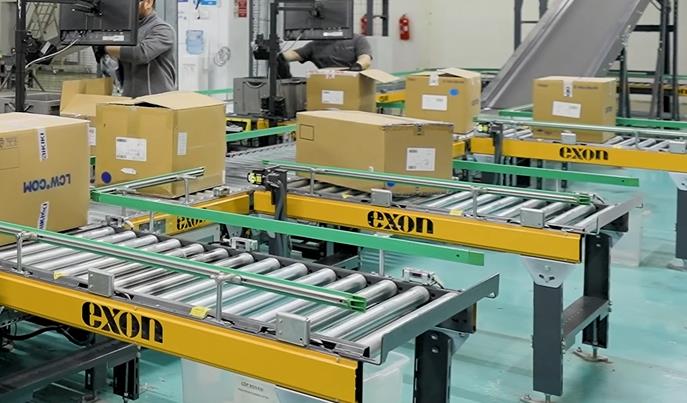
- Picking and packing: totes or order cartons queue in an accumulation zone in front of the station. A completed order joins the main line at a merge point.
- Shipping and truck loading: cartons are split by loading dock. They wait on the line while the truck is not ready. They are then loaded with a telescopic conveyor.
Common mistakes in conveyor projects
- Sizing the line for average volume. A line built for average volume may fill its accumulation zones at the first sales campaign. The queue spreads back through the line.
- Taking speed for throughput. Without gap control, higher speed does not raise throughput. Items collide or go unread at merges and at sorter induction.
- Running polybags on roller conveyor. Polybags and envelopes can catch, turn or fall between rollers. In polybag-heavy flows these sections should be belt conveyors.
- Adding accumulation later. If you do not decide up front where the line will wait, one short station stop can halt the whole line. Accumulation zones are designed together with the layout.
- Thinking about controls and software after the mechanics. Decide early who makes the routing decision. The path for no-reads and the message format need the same early decision. Left to the end, they make commissioning longer.
Cost and quotation
The price of a conveyor line depends on its length, layout, item size and weight. Peak-hour throughput and the number of accumulation, merge and divert points also count. Controls and software scope and site conditions are part of the price too. Exon first collects your item and flow data. It prepares a 3D layout before the quotation and prices from it. Read more: what determines the price of a sorter or conveyor system?
Rolling On Interroll Approved Partner
Exon Robotics is a Rolling On Interroll Approved Partner. The certificate is valid from April 2026 to March 2027. Exon has completed Interroll product training. It has also successfully installed at least one of Interroll's core product technologies. Exon's partner page
More questions
How does a conveyor project with Exon start?
Exon first reviews your requirements. Item sizes and weights, peak-hour volume, the building plan and the flow between areas are discussed. Exon then prepares a 3D layout before the quotation and prices from it. If needed, the warehouse is modeled in a Demo3D simulation before the project. Flow at accumulation and merge points is tested before installation.
How is conveyor speed determined?
Speed is calculated backward from the required throughput. Add the item length and the gap between items. Multiply this by the number of items per hour. Divide the result by 3,600 to get the speed in meters per second. Line sections can run at different speeds, because reading, measuring and sorter induction need gap control.
Can a conveyor line be added to a running warehouse?
Yes, usually in phases. The line is installed section by section, and each section goes live after testing. During the changeover, part of the flow runs on the existing setup. The installation plan is set to finish before peak season. The layout study decides which existing equipment stays and how it talks to the software.
Exon conveyor types
Get a quote for your project
Tell us briefly what you need and our team will get in touch.